
Short story
Stories
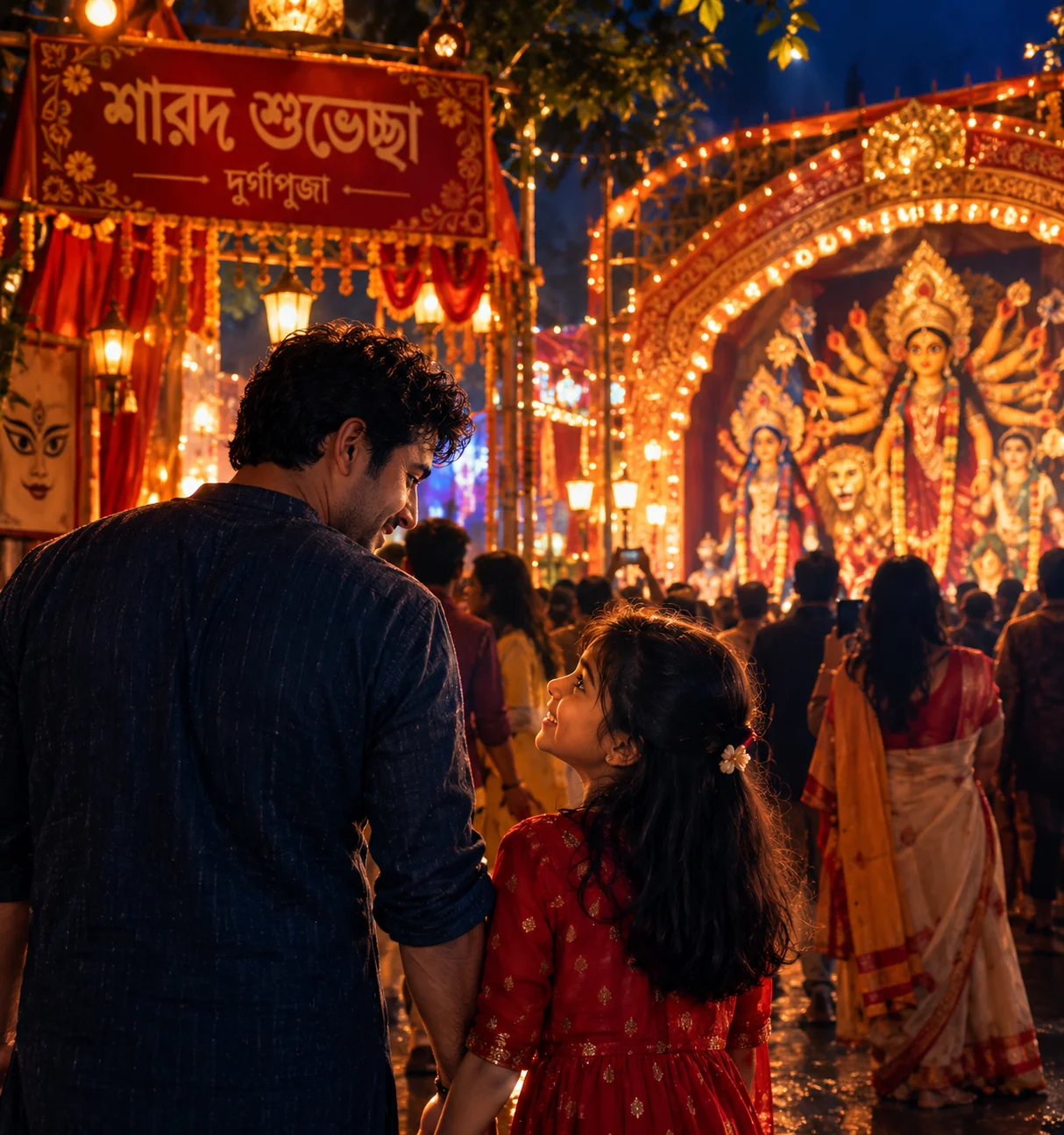
Ashtami Night
On the busiest night of the festival, a father looks away for one minute. A long story of a lost child, a missing woman, an old grief, and the way home.
Mr. Deb · 29 September 2026 · 28 min read
This is a work of fiction. Any resemblance to real people is coincidental. About a thirty-minute read.
8:40 p.m.
The dhak drums began the way they always begin on Ashtami night: not with a sound, but with a change in the air, as if the whole city had drawn one deep breath and was about to sing.
Arnab Sen stood at the mouth of the lane with his daughter's hand in his, and the crowd went past him like a river that had decided, tonight, to run uphill.
Everywhere he looked, there was light. Strings of it hung across the narrow lane from balcony to balcony, thousands of small yellow bulbs blinking like a sky that had come down to be closer to people. Red and gold paper lanterns swung from bamboo poles. Above the rooftops the great arch of the pandal rose like a painted cliff, all silver tinsel and shining thread, and from inside it came the slow, deep, rolling thunder of the drums and the sharp, sweet ringing of the bells.
The smell reached him a moment later. Sandalwood and smoke. Frying oil and sugar and wet marigolds. The sweet, choking cloud of dhunuchi incense, in which women in red-bordered white saris danced with clay burners in their hands, and their faces glowed like faces in an old painting.
"Baba! Baba, look!"
Mishti was jumping on her toes, tugging at his hand. She was six years old, and she wore a small red lehenga with a border of gold, and her hair had been tied into two tight, shining plaits by her mother, who had done it that afternoon without once looking at him.
"I am looking," said Arnab.
"You are looking at your phone."
He was. He put it away, a little guiltily. It had buzzed four times on the way. His office. A release that had gone wrong somewhere, a server somewhere that had fallen over. For eleven years, that phone had been the one thing that could reach into any room of his life and pull him out.
"Sorry, Mishti. Done. No more."
She gave him the long, judging look of a small person who has heard this promise before and has filed it, carefully, under not likely.
"You said that at my birthday."
"I know."
"And at school on the Annual Day."
"I know."
"And at Ma's..." She stopped. She looked down at her small gold shoes.
He knelt. The crowd broke around them, complaining, and closed again.
"I am here tonight," he said. "All night. Only you. Ashtami. We will see every pandal on the list. Ma made the list. Look. We will do all of it."
Her face lit, all at once, like a lamp turned up. "Every one?"
"Every one."
"Even the one with the giant Mahishasura?"
"Even him."
"Promise?"
Arnab looked at her, at the two plaits and the small serious chin, at his wife's eyes in his daughter's face, and something turned over quietly in his chest.
"Promise," he said, and meant it, with all of himself.
He did not know it, but the clock over the sweet shop across the lane said 8:41, and in exactly eighteen minutes, he would break it.
8:59 p.m.
The first pandal was wonderful.
The goddess stood ten feet high on her lion, in a blaze of gold and crimson, with her ten arms raised and her eyes wide and fierce and tender at once. At her feet, the demon king writhed, a huge green figure with a twisted face, and Mishti stood in front of him with her mouth open and said, in a whisper of the purest satisfaction, "He is so ugly."
Arnab laughed. It was the first real laugh he had had in months. He took a photograph of her looking at the demon, her small red back and the gold of her belt, and thought: I will show this to Ritika.
And the thought, as it always did lately, arrived with a small cold stone attached.
Ritika had not been in the house for eight months. She had gone one night in January with two suitcases and Mishti's school bag, and she had not slammed a door or shouted a word. That was the worst part. She had simply stood in the hall, in her grey cardigan, with her hands folded, and said very quietly: "I cannot live in a house where I am the only one who is present."
He had wanted to answer. He had opened his mouth. And his phone had rung, in his pocket, on the exact word, and he had looked down at it. Only for a second. Only out of habit.
She had looked at that second, and at him, for a long time.
Then she had picked up the suitcases and gone out into the cold.
That was the winter after the other thing. The thing they never said. The small blue blanket that was folded in the wardrobe, never opened, never taken out. The room they had painted yellow, and afterwards kept shut. The month in which every silence in the house had a shape.
Rihaan, Ritika had named him, before he was born. They did not use the name. They did not use anything, in that house, after.
"Baba!"
Mishti was pulling him toward the exit. "Next one! You promised!"
"Coming, coming."
His phone buzzed.
He did not look at it. He held it out, as if it were something hot, and switched it off. He did it slowly and deliberately, with Mishti watching, and slid it into his pocket.
"There," he said. "Off."
Mishti stared at him as if he had performed a small miracle. Then she took his hand in both of hers, and squeezed it, and led him out into the lane.
9:20 p.m.
By nine-twenty, the crowds were something you could lean on.
The lane to the second pandal was a single narrow artery, and it was jammed with people from wall to wall. Families with grandmothers on their arms. Young men with their shirts open, singing. Girls in silk saris in twos and threes, arm in arm and giggling. Vendors shouted from every doorway: Bhutta! Phuchka! Cotton candy! Balloon, balloon, balloon! A boy with a tray of tiny glowing swords pushed his way through, calling. Somewhere overhead, a loudspeaker was playing an old song, scratchy and warm, about a mother who comes home for four days a year.
Arnab held Mishti's hand in a grip so tight that she complained.
"You are squeezing."
"Sorry."
"Baba, I am not a baby."
"I know. It is crowded. I don't want to lose you."
"You won't."
"I know."
They moved with the crowd, in short shuffling steps. Ahead of them, a man was carrying a toddler on his shoulders, and the toddler was waving a balloon and shrieking with joy at everything. Mishti looked up at the toddler with a lofty air.
"Baba," she said. "Why did Ma not come?"
The question landed without warning.
He looked at the back of a stranger's head. He said, carefully: "Ma is at Nani's house. She said she was tired."
"She is not tired." Mishti said it in a small, perfectly certain voice. "She is sad. She is always sad. When I asked why, she said it is because she misses someone."
"Who?"
"She did not say." Mishti swung his hand a little. "I think she misses you."
The crowd surged. Someone's elbow struck Arnab in the ribs. He barely noticed.
"Ma said that?"
"No. I think that." She looked up, with the appalling honesty of the very young. "Baba, if you miss Ma also, you can just go and say. It is not so difficult."
He opened his mouth.
And a man in the crowd, pushing past with a large tray of jalebis, collided with his shoulder. The tray tilted. Syrup slopped across Arnab's arm. The man swore, and Arnab swore back, and for four seconds, five, six, they were locked in an absurd and furious little tangle of elbows, and someone laughed and someone shouted, and the tray was righted, and the man was gone.
Arnab wiped the syrup off his shirt, breathing hard.
He looked down.
His hand was empty.
9:34 p.m.
It is a strange thing, that first second.
Nothing happens at all. The world goes on exactly as it was. The lights blink. The drums roll. A woman two feet away laughs at something on her phone. Only inside you, at a place no one else can see, a single small silence opens, like a crack in a glass.
"Mishti?"
Not a shout. Not yet. He said it in an ordinary voice, as though she were in the next room.
"Mishti?"
He turned. The crowd went past him in every direction. Legs. Saris. Balloons. Somebody's hip, somebody's bag. A forest of moving strangers, all of them taller than his daughter.
"Mishti!"
Now it was a shout.
A woman glanced at him and away.
He pushed forward, ten steps, twenty. He knelt on the cold stone and looked along the ground for a flash of red. He stood on the edge of a step and searched the tops of heads. He saw a plait, a red skirt, and his heart jumped like a fish, and he plunged toward it and seized a shoulder, and a stranger's child turned, frightened, with a face that was not hers at all.
"Sorry," he gasped. "Sorry. Sorry."
He ran back. He ran forward. There was a jalebi vendor and a balloon seller and a man with a trumpet, and he asked all of them, his voice cracking. A girl. Red lehenga. Six years. Two plaits. Have you seen a girl? And every one of them looked at him with the same helpless, kindly, useless face, and said: So many children, dada. So many.
He took out his phone.
It was off.
He had turned it off. He had done it himself, five minutes ago, to show his daughter that he was a man who kept his promises.
His fingers were shaking so badly that he could not hold the button. When the screen finally woke, it showed eleven missed calls. He did not care about any of them. He opened the contacts and pressed the name he had not pressed in two months.
It rang once.
"Arnab?"
Ritika's voice. Sleepy, surprised, and guarded.
"Ritika." His own voice was a stranger's. "Ritika, I..."
Something in the way he said it made her go absolutely still.
"Where is Mishti?"
"I lost her," said Arnab.
And on the other end of the line, he heard a sound that he would carry for the rest of his life: not a scream, not a word, but the small, dry click of a person who has stopped breathing.
9:52 p.m.
The pandal committee's office was a bamboo shed with a tin roof, a folding table and a single hanging bulb. Around the table stood four men in kurtas and a young volunteer with a walkie-talkie and a badge that said BITTU. A ceiling fan turned slowly overhead, stirring the smell of tea and sweat and scorched incense.
"Lost child, lost child," said the loudspeaker, in a flat, careful voice. "A girl, six years old, red lehenga, two plaits, answering to the name Mishti. Please bring her to Gate Three."
It said it again. And again. And the words went out over the crowd and lost themselves in the drums.
Arnab stood at the table. He could not sit down. He had not sat down since he ran in. His shirt was stuck to him and there was a long smear of syrup on his sleeve, and he kept looking at it, as if it were the only thing in the room that made any sense.
"Sit, dada," said one of the men, kindly. "Have some tea."
"I don't want tea."
"It happens every year. Ten, twelve children. They always turn up. Always."
"Always?" said Arnab.
The man hesitated. It was a very small hesitation, and Arnab caught it and held it, like a thorn.
The door banged open.
Ritika stood in the doorway.
She had come from her mother's house faster than the journey should have taken, and she had not stopped to change. She was in a cotton salwar, slightly crumpled, with her hair unpinned, and no shoes on her feet except a pair of house slippers, one of which had come half off. She stood in the middle of the shed, looking at him.
He had prepared, on the way there, for a hundred things she might say. He had prepared for anger, for cold, for the terrible level voice she had used in January.
She did not say anything.
She crossed the floor in four steps and slapped him across the face.
The sound cracked against the tin roof. Bittu flinched. The men looked at their own feet.
"You promised," said Ritika. Her voice was small and shaking and completely without mercy. "You promised me. You swore. You said it would be different. I gave you one night, Arnab. One night. I gave you the one thing that I have left."
"Ritika..."
"On the phone? Was it the phone?"
"No. It was..." He stopped. He looked at her, at the hand that had struck him, which was now trembling and clenched against her chest. "It was a man with a tray. Jalebis. It was six seconds. I turned around."
"Six seconds." She began to laugh, a terrible, breaking sound. "Six seconds. And before that? The forty minutes before that? The eleven years before that? Where were you, Arnab? When was the last time you were there?"
He had no answer. There was only the fan, turning slowly overhead, and Bittu's walkie-talkie muttering, and the far-off thunder of the drums.
"Find her," said Ritika. "Just find her. After that you can do what you like. Leave. Stay. Break every promise you have. But find her."
She turned away. Her shoulders, in the yellow light, were shaking.
And Arnab, whose whole life had been built on the belief that any problem could be solved by the right machine, the right code, the right tool, stood in a bamboo shed with his cheek burning and understood, for the first time, that there was nothing in the world he could do except walk out into that river of strangers and look.
10:30 p.m.
The police arrived at a quarter past ten. There was a sub-inspector called Rahman, a short, stocky man in a crumpled uniform with tired, careful eyes. He sat them down on two plastic chairs, and asked the questions in a low, level voice that Arnab was grateful for and hated.
Time last seen. Description. Photograph. Any enemies. Any disputes.
"Custody?" said Rahman gently.
"What?"
"Are you and madam... together? Living together?"
Arnab said: "No."
"Is there any chance that... a relative? A family member?"
"No," said Ritika, very fast. "No one. There is no one."
"I have to ask."
"I understand."
Rahman wrote something on a pad. Then he looked up, and asked the next question in the same even tone.
"Did anyone see anything?"
Nobody had. Nobody had seen anything at all. They asked the jalebi seller, who had gone home. They asked the balloon man, who said he had seen a hundred girls in red. They asked the men at the entrance to the second pandal, who said the crowd had been too thick to see the ground.
They went through the crowd, Arnab and Ritika, side by side and a yard apart, not speaking, every so often each of them calling the name in a voice more cracked than the last. Mishti! Mishti! And the name went into the noise and was swallowed.
At twenty to eleven, a small boy tugged at Arnab's sleeve.
He was perhaps nine years old, thin and barefoot, with a tray of paper flowers hanging from a string around his neck. His eyes were enormous.
"Dada," he said. "The girl. Red dress. With gold on the bottom."
Arnab went cold to the roots of his hair.
"Yes. Yes. Where?"
"I saw her." The boy pointed, with a grubby finger, down the lane, toward the river. "She was holding a lady's hand."
"What lady?"
"An old lady. In a white sari." He thought. "With a red border."
Ritika had come up beside them. Her face was the colour of paper.
"Was she crying? The girl?"
"No," said the boy, puzzled. "She was talking. She was telling the old lady something. And the old lady was laughing." He frowned. "No. Not laughing. Crying. And laughing."
"Where did they go?"
"That way," said the boy, and pointed again, into the dark, past the last string of lights.
Toward the river.
11:15 p.m.
There is a place, at the end of that lane, where the lights simply stop.
The bulbs give out, and the paper lanterns, and the last stall with its fried snacks. There is a rusting iron gate and, beyond it, a long flight of stone steps going down into darkness, and at the bottom of the steps, invisible, broad and slow and very cold, the river.
Arnab had been afraid of the river since he was a child.
He did not tell anyone that. It was a small, stupid, private fear that had never mattered. But tonight it came up in him like a tide, a thick black wave, and he stood at the top of the steps with Ritika beside him, and he could not move his feet.
"Arnab," said Ritika.
"I know."
"She could be..."
"I know."
Inspector Rahman was already going down. He had a torch, and the beam swung out ahead of him over the stone, over the wet green edges of the steps, over a scatter of marigolds that some earlier worshipper had left behind. The river, when the beam touched it, looked black and slick and enormous, like the skin of a great sleeping animal.
They went down. Fifty steps. Sixty. The music of the festival grew fainter behind them until it was only a single low pulse, like a heartbeat heard through a wall.
"Mishti," said Arnab, and his voice went out over the water and did not come back.
Nothing.
"Mishti."
The torch swung right, along the ghat, over pillars and broken arches and a long row of darkened shrines. A pair of pigeons burst up out of a niche, and Ritika gave a cry.
"Wait," said Rahman.
He had stopped. The beam had come to rest, and held.
Far along the ghat, near the water, where the last of the steps ran out into the mud, something was glimmering.
A small, wavering, yellow light.
It was a lamp. A single earthen lamp, floating, or half floating, in the shallows. And beside it, on the lowest step, two shapes sat close together in the dark.
One was small.
The other was bent, and thin, and wrapped in white.
Ritika made a sound like something tearing.
She was down the steps before either of the men could stop her. Her slippers were gone. Her bare feet slapped on the wet stone. She ran as she had not run since she was a girl, with her hair flying and her arms out, and Arnab ran behind her, and the torch bobbed and swung across the water. He could hear his own breath sawing and could not tell whether he was sobbing or shouting or praying.
The small shape turned.
"Ma?"
The voice was thin and sleepy and completely unafraid.
"Ma! Ma! Look! I found Dida!"
11:38 p.m.
Ritika had her on her lap. She had gathered Mishti up off the step in one movement and held her against her chest with both arms and both knees and her whole body, rocking, rocking, murmuring the same three words over and over into her hair. My baby, my baby, my baby. Mishti submitted to this with the patient courtesy of a child who has been kissed by her mother before.
"Ma, you are squashing me."
"I know."
"Ma, you are crying on me."
"I know."
"Ma." Mishti put both small hands on her mother's wet cheeks and considered her gravely. "Why are you crying? I am fine. I was with Dida."
Arnab was on his knees on the wet stone. He could not stand. He had put his hands over his face, and every inch of him was shaking. When he took them away, he found that the old woman was looking at him.
She was very old. She sat on the bottom step with her feet in the water, and her face, in the torchlight, was a landscape of fine lines. Her hair was thin and white. Her white sari, with its narrow red border, was soaked to the knee. Her eyes were a pale, cloudy, brown-gold colour, and they were wet, and full of a terrible tenderness.
"Your daughter is a very good girl," she said.
Her voice was so soft that he had to lean closer.
"She found me at the sweet stall," said the old woman. "I was lost. I am always lost. I forget the way home, now, and I forget the names. I was sitting on a step and I was frightened, and this small one came and sat beside me. She said, Dida, why are you crying?"
She smiled, and the smile broke, like a crack running across an old plate.
"I said, I cannot find my son. She said, I will help you. And she took my hand."
"She walked you here?" said Rahman, wonderingly.
"I told her," said the old woman. "I told her, I want to go to the river. It is the eighth night. I have a lamp to float. It is for my daughter. She was six years old." She lifted her hand from her lap, and it trembled in the air. "Thirty-one years ago. In this crowd. Ashtami night."
Nobody spoke.
"I lost her," said the old woman. "In one moment. In the crowd. And I never found her."
The river went by in the dark, wide and quiet, carrying its flowers.
"Every year I come," she said. "Every year, on this night, I float one lamp. I ask for her forgiveness. And this year I forgot the way, and this child, this small brave child, took my hand and brought me. She told me the names of the streets, one by one, and she sang me a song."
Mishti, in her mother's arms, said with dignity: "It was Ma's song."
"What song?" whispered Ritika.
"The one you sing. Ghum parani mashi pishi. When you think I am asleep."
And Ritika, who had held herself together for two long hours, whose spine had been a rod of iron since January, put her face against her daughter's small red shoulder and broke completely.
11:50 p.m.
For a long time nobody spoke. The four of them sat at the edge of the water, the old woman and the mother and the child and the father, and the lamp bobbed away slowly on the black river, a small gold star drifting.
Rahman had stepped aside, courteously, to make a call. Somewhere far above them, the drums rolled on.
Arnab had not moved from his knees. Mishti climbed down from her mother's lap, and came over to him, and looked at him with a peculiar and searching expression.
"Baba," she said. "Are you angry?"
"No."
"You look angry."
"I am not angry." His voice cracked. "I was so afraid. I was so afraid, Mishti. I thought..."
"I know." She patted his cheek, briskly, as one comforts an elderly relative. "But I was not lost, Baba. I knew where I was. I was helping Dida."
"You should not have gone away."
"You were fighting the jalebi man."
He laughed. It hurt. It came out of him like something dredged from a well, and it turned, halfway, into something else.
"Yes," he said. "Yes. I was."
"Baba." She took his face between her hands. Her palms were sticky with sugar and the river. "Dida said something to me. I want to tell you."
"What did she say?"
"She said that when she lost her daughter, she had her back turned for one minute. And her husband said it was her fault. And she said it was his. And they said it to each other for so long that after a year, there was no one left in the house to say it to." She frowned, choosing the words. "She said, Do not let the person you love become the person you blame."
The river was very still.
"She said that to you?" said Arnab.
"She said it to me. But I think," said Mishti, with great solemnity, "she meant it for you."
He looked up.
Ritika was watching him. She had stopped crying. Her face was blotched and swollen and lit from the side by the flickering torch, and she looked, he thought, exactly as she had looked on the day they met, in a rainy bookshop on College Street, with a wet umbrella in one hand and a novel in the other. There was something in her eyes that he had thought was gone. It was hidden a long way down. But it was there.
"Ritika," he said.
"Not now."
"I have to say it."
"Arnab..."
"I was not there." He said it clearly, into the dark, with the old woman listening and his daughter's hands on his face. "You said it in the shed, and you were right. I was not there. Not tonight. Not last winter. Not in the hospital, when it happened. I sat in the corridor with my phone, and I told myself that I was being strong, and I was only running. I was running from a room I could not bear. And I left you in it alone."
The torchlight shook. Somewhere, very far off, a conch began to blow.
"I cannot bring him back," said Arnab. "I cannot un-lose him. I wish to God I could. But I can sit in the room. If you let me. I can sit in the room with you, and say his name. And I will not look at my phone."
The silence went on for so long that he thought she had not heard.
Then Ritika slid off the step, and sank down onto the wet stone in front of him, and took his face between both her hands, just as their daughter had.
"Say it," she said.
"Say what?"
"His name."
He swallowed. It had been two years. He had not said it once. The word was a small, sharp stone at the back of his throat.
"Rihaan," said Arnab.
It came out cracked, and rough, and broken, and it went out over the river, and nothing at all fell down from the sky.
But Ritika closed her eyes, and a tear ran down between her fingers and onto his skin, and she said very softly, "Again."
"Rihaan."
"Again."
"Rihaan. Rihaan. I am so sorry. I am so sorry, my love."
She pulled his head down against her shoulder, and he wept as he had never wept in his life, in great tearing breaths, in front of a stranger and a child and a river, and she held him and rocked him and stroked his hair, and said his name back to him, over and over, like a lullaby.
12:20 a.m.
The old woman's son came at twenty past midnight.
He came stumbling down the ghat steps, with two policemen and a torch, a heavy grey man in his sixties in an untucked shirt, sweating and wild-eyed. He had been searching the city since dusk. Rahman had reached him by phone, but it took him forty minutes to cross the crowds. He came down onto the last step and stopped, with the torchlight shaking in his hand.
"Ma."
The old woman looked up. Her cloudy eyes moved across his face, uncertain.
"Kaushik?" she said, at last. "Kaushik. Where were you?"
"I was looking for you." His voice broke. "I was looking for you, Ma. I have been looking everywhere. Every year you say you are going to the temple, and every year I follow you, and tonight there was a crowd, and I lost you. I lost you at the gate. I turned around, and you were gone." He dropped to his knees on the stone. "Ma, I am so sorry."
"Thirty-one years," said the old woman, softly, "and a man still says he only turned around."
Arnab and Ritika looked at each other.
Kaushik took his mother's hands. He was weeping openly, without shame.
"She has been like this since Baba died," he said, to no one, to all of them. "She forgets the way. She forgets my name. I have three locks on the door, and she still gets out. I do not know what to do."
"She did not forget everything," said Mishti, from Ritika's lap.
They all looked at her.
"She remembered her daughter," said Mishti. "She told me her name. It was Mishti also."
Nobody breathed.
"What?" said Kaushik.
"Her name was Mishti," said the old woman, in a whisper. "My little girl. My Mishti." She raised one thin, trembling hand and laid it, very gently, on the small red-and-gold shoulder. "I saw this one at the sweet stall, and I thought, that is my girl. And I knew it was not. But it was enough. For one night, it was enough."
Kaushik put his head in his mother's lap. Arnab looked at the river, at the last shreds of the lamp's light far away on the water.
And he thought: There are so many ways to lose a child. There are so many ways to lose a person. He thought of the small blue blanket in the wardrobe. He thought of eight months of silence. He thought of every year that Kaushik's mother had walked toward this dark water, alone, carrying her one little lamp.
And there is only one way to find them, he thought. You have to stay in the room.
1:05 a.m.
They took the old woman home in a police jeep.
It was Ritika who insisted, and Kaushik who wept again, and Rahman who said gruffly that it was not procedure but that procedure could wait. She sat in the back seat with her son's arm around her, and her lamp-blackened fingers clasped in her lap, and Mishti hung out of the window and waved until the jeep turned the corner.
"Dida said I am welcome any time," she announced. "She said she will teach me to make payesh."
"Payesh is very hard," said Ritika.
"I don't mind."
They stood in the empty lane. The festival was still going. It would go on until dawn, until the last drum, but the crowd had thinned, and the lights, which had seemed so wild at nine o'clock, now blinked gently on the shuttered stalls like tired stars. A street sweeper was already at work down the far end, dragging his broom along the paving with a long, patient rasp. A dog padded by, sniffing at fallen marigolds.
Mishti yawned enormously.
"I am hungry," she said.
"Of course you are," said Ritika. She looked at Arnab. It was the first time she had looked directly at him since the ghat, and there was something odd and unguarded in her face.
"There is a place near the tram depot," said Arnab, slowly. "It is open all night. They make the best luchi and aloor dom. It used to be..."
"Our place," said Ritika.
"Yes."
"After the Puja pandals. Every Ashtami. The year we were married."
"I had forgotten," said Arnab, "that I remembered it."
She laughed. It was a small, worn, rueful sound. And then, without a word, she held out her hand.
He took it.
It was a small hand, and cold, and its fingers were still a little unsteady. But it closed on his without hesitation, and there was a promise in it that had not been there in eight months. It was not the promise of forgiveness. Nothing in the world could be so simple. It was the promise of a person who has decided, at least for tonight, to stay in the room.
They walked down the lane together with Mishti between them, holding a hand in each of hers, swinging them and humming to herself. Above them, the goddess's arch glowed gold against the black sky. From somewhere far off came the last, slow, beautiful rolling of the drums.
Arnab reached into his pocket, took out his phone, and looked at it.
Forty-three missed calls. Eleven messages. A red banner across the screen that said URGENT: PRODUCTION DOWN.
He held the button until the screen went dark. Then he put the phone back in his pocket, and he did not take it out again.
Dashami
They brought the goddess to the river on the tenth day, as they do every year.
It was a warm bright afternoon. The whole city seemed to have gathered on the banks, thousands upon thousands, the men in white kurtas, the women in red and white, the children on their fathers' shoulders. The drums were beating a slow, heavy, sorrowful rhythm, as they always do on the last day, the day of leaving, when the mother goes back to her mountain and everyone pretends not to cry.
Ritika stood at the water's edge in a red-bordered white sari that she had not worn for two years.
She had taken it out of the wardrobe that morning. It had been folded beside the small blue blanket, in the drawer that neither of them had opened. She had gone into the bedroom of the old flat, the flat that was still, after all, hers, and stood a long time, and then, without saying anything, opened the drawer.
Arnab had found her sitting on the floor. He had sat down beside her. They had taken the blanket out together. They had held it, and said the name, and cried until the light changed on the wall.
Then they had gone to the river.
Now there was a plate in her hands, with vermilion on it, and sweets, and a single small lamp, and in front of her, on the wet stone, an old woman in a white sari sat on a folding stool with her son beside her.
"Dida," said Mishti, and ran to her.
Kaushik's mother looked up. Her eyes, in the bright afternoon, were clearer than they had been that night, and for a moment they seemed to see everything: the child, the mother, the river, the drums, the day.
"There she is," she said. "There is my Mishti."
She held out her arms. Mishti went into them, and they held each other, the old woman and the child, and the whole bright noisy river seemed to go quiet around them.
Ritika stepped forward.
"Dida," she said. She could hardly speak. "May I?"
She touched a little of the vermilion to the old woman's forehead. Then, gently, she took a pinch of it to her own, and Arnab, beside her, standing very still with his hands at his sides, saw the colour go up her parting like a small red flame.
"Come," said the old woman to her, in a whisper. "Come. Bless him."
Ritika turned.
He did not know what to say. He was a man who had built his life out of words, and there were none. So he stood there in the hot sunlight and simply looked at his wife, and she looked back at him, with the red on her brow and the river shining behind her, and neither of them moved.
"I am coming home," said Arnab, at last. "If you will have me. Not because of a night. Not because of a promise I will probably break. But because I want to be in the room. For all the days. For the bad ones too."
"You will break some of them," said Ritika.
"Yes."
"You will look at that phone."
"Yes. And you will tell me. And I will put it down."
She looked at him for a long moment. Then something in her face gave way, softly, like snow sliding off a roof in the first warm morning, and she laughed. It was a wet, astonished laugh, and it was the sound he had loved most in the world, and had not heard for so long that he had forgotten it was a sound at all.
"Come home, Arnab," she said.
Above them, the drums swelled. The great gold goddess was lifted by a hundred hands and carried, swaying, down the ghat steps, her ten arms raised, her face calm and fierce and tender, toward the river that had once been the thing he feared most in the world.
Mishti, still in the old woman's arms, said loudly: "Baba! Ma! Look! She is going home!"
"Yes," said Arnab, and took his wife's hand, and lifted his daughter onto his shoulders, and stood with them at the edge of the water while the whole city sang the goddess out into the light.
"So are we," he said.
Reviews
- No reviews yet. Be the first.
fictionfamilyfather and daughtersuspenseDurga Pujalong read