
Short story
Stories
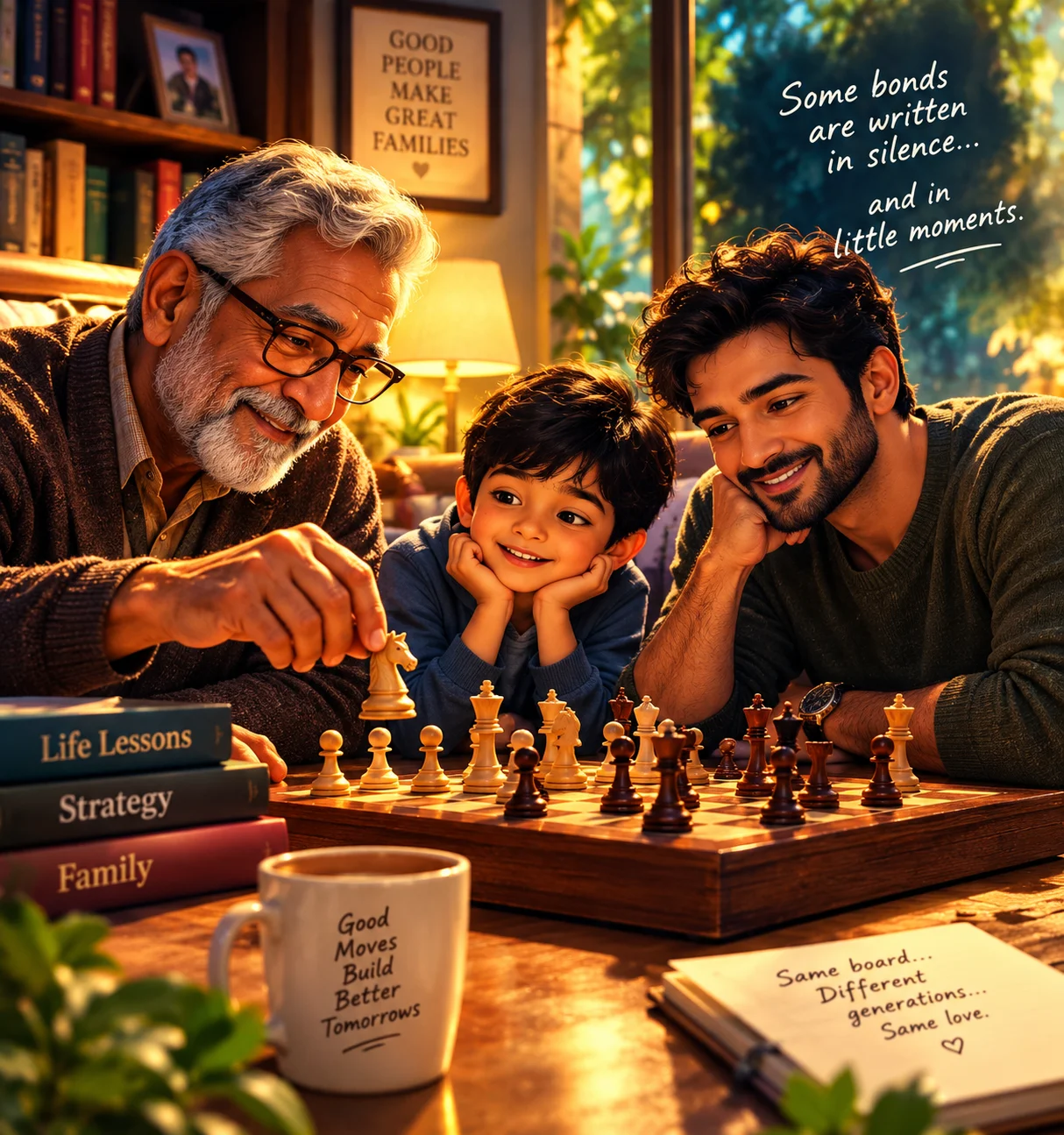
The Last Game of Chess
A son, his father's old chessboard, and a game that remembers what a mind cannot.
Mr. Deb · 27 September 2026 · 5 min read
This is a work of fiction. Any resemblance to real people is coincidental.
The chessboard lived on a small table by the window, and it had lived there for as long as Rohan could remember. The wood was worn pale at the corners where a thousand hands had reached for a thousand pieces. One white bishop had lost his head in some forgotten argument and been glued back on, slightly crooked. Nobody had ever thought of replacing him.
"He is a survivor," his father used to say. "Every board needs one."
Rohan had not sat at that board in eleven years.
He drove down on a Saturday, because his sister had called and said, in the careful voice people use when they are holding something breakable, "Come soon. Baba is having more bad days than good ones."
It began, she explained, with small things. The keys in the refrigerator. The names that slid away mid-sentence. A man who had once corrected everyone's grammar, and could recite any date in the history of the town, now stood in the kitchen at midnight, asking where he had put the morning.
The doctors had a long word for it. The family used a shorter one: forgetting.
Rohan brought his son with him, Aarav, who was seven and carried a tablet like a shield against the unfamiliar. In the car he asked, "Is Dadu going to know who I am?"
"I do not know," said Rohan, and it was the truest, hardest thing he had said all year.
His father was sitting by the window in his old cardigan, hands folded, looking at the street with mild, polite interest, the way you look at a stranger's garden.
"Baba," said Rohan. "It is me. Rohan."
His father turned. For one long second, something moved behind his eyes, a light passing through a house at night, room to room, searching. Then it settled.
"Ah," he said warmly. "You look like someone I know. Please, sit."
Rohan sat. His throat closed. He had rehearsed, on the drive, a hundred things to say. Every one of them had gone.
Aarav hovered at the door, tablet clutched to his chest.
And then Rohan's eyes fell on the small table by the window.
"Baba," he said, before he could think. "Shall we play?"
His father looked at the board as if seeing a familiar song on a radio in another country. His hand moved, slowly, toward a white pawn.
The pieces, at first, meant nothing to him. He held a knight in his palm and turned it over, frowning. "This one jumps," he said, uncertain. "I think it jumps."
"It does," said Rohan gently. "L-shaped."
"L-shaped," his father repeated, delighted, as though Rohan had handed him a gift.
They set the pieces up together, slowly, Rohan correcting the order, his father nodding as if he had known it all along. He moved his king's pawn two squares forward, the very first move he had taught his son, at this same table, thirty-odd years ago.
Rohan answered the move the way he had always answered it.
And something extraordinary began to happen.
His father did not know the day. He did not know the year, or the name of the town, or how many children he had. But when Rohan's bishop crept out toward the diagonal, his father's hand hovered, hesitated, and then, without a word, slid a pawn forward to close the door. The exact move. The one he had made a thousand times, the trap he had set when Rohan was ten, and thirteen, and sixteen.
"Careful," his father murmured, eyes bright. "That is how you lose your queen."
Rohan laughed. It came out broken, something between a laugh and a sob.
"I know, Baba," he said. "You taught me."
At some point Aarav crept closer. He climbed onto the arm of the chair, tablet forgotten on the floor, and watched the pieces with the grave attention of a child who senses that he is witnessing something important.
"Dadu," he whispered. "Which one is the horse?"
His grandfather looked at him. The searching light passed through the house again.
"This one," said his father slowly, placing a small, warm knight into the boy's palm. "He is brave. He jumps over the others when he has to. Do you know why he is the best piece?"
"Why?"
"Because he is not afraid to go the strange way around."
Aarav closed his fingers around the knight, solemn as a vow.
"Will you teach me?" he asked.
A long silence. Outside, a bicycle bell rang. The clock ticked over the mantel.
"I do not remember much," his father said at last, softly. "But I remember this. Come. Sit here. I will show you the first move."
They played until the light went orange, and then grey. Rohan lost, deliberately, and his father, who had never in his life allowed a lost game to pass without comment, said only, "Good game," and patted his hand.
Later, when Aarav had fallen asleep on the sofa with the knight still in his fist, Rohan stood by the window with his sister, and she asked, "Did he know you?"
He thought about it for a long time.
"I do not think he knew my name," he said. "But I think he knew me."
He turned back to the small table, to the worn corners and the crooked-headed bishop, the survivor that every board needs.
The mind forgets. He understood that now. It forgets names and dates and the way home. But somewhere underneath, in the hands, in the habits, in the quiet places where love had been practised again and again, something keeps the board set.
He took the bishop, gently, and placed him back in his square.
"Same time next Saturday, Baba," he said to the empty room, and to the man asleep in the next.
And he meant it.
Reviews
- No reviews yet. Be the first.
fictionfamilyfather and sonchess