
Short story
Stories
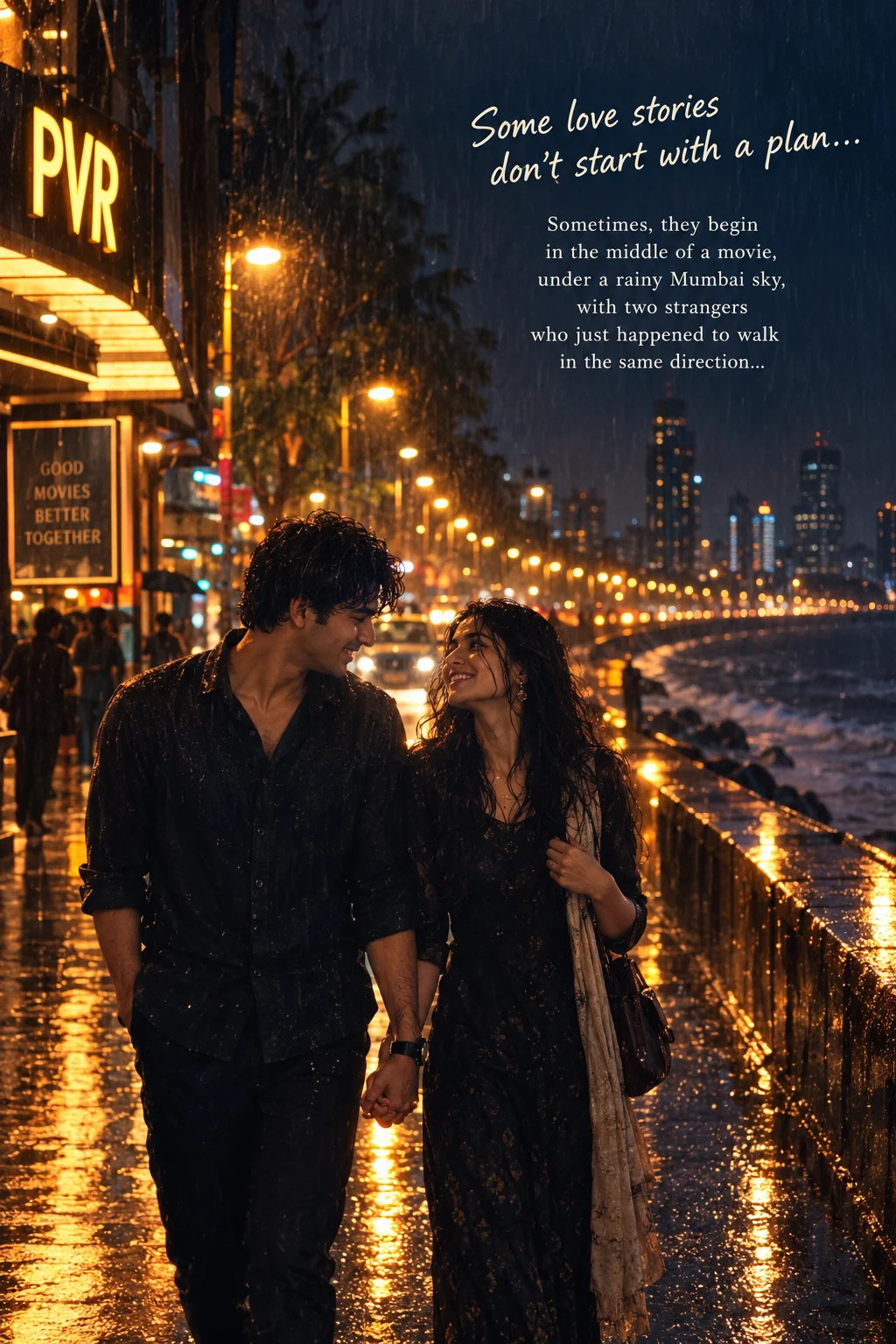
Twelve Streets in the Rain
One late film, one missed auto, one borrowed jacket, twelve wet streets under a full moon, and a question Kabeer was not ready to hear.
Mr. Deb · 28 September 2026 · 15 min read
This is a work of fiction. Any resemblance to real people is coincidental.
The film
The hall was old and smelled of dust and warm popcorn and the faint, sweet ghost of a thousand evenings. The seats were red once, a long time ago. Now they were the colour of tea left too long in a glass, and the springs inside them sighed whenever anyone shifted.
Kabeer had bought the tickets three days earlier and then spent three days pretending it was nothing.
"Just a film," he had said to his roommate, tying his shoelaces twice. "Just a friend. Just a Saturday."
His roommate had looked up from his book and said nothing at all, which was worse.
Now the lights went down. A cone of silver dust swam out of the little window at the back and the screen woke slowly, like a dark lake catching the first light. Priya, beside him, drew her knees up a little and folded her hands in her lap, the way she did in the library when the teacher entered. She was wearing a plain yellow kurta, the colour of the inside of a marigold, and a thin silver chain that caught the screen light and let it go.
He had known her for two years and three months. He knew how she held her pen, how she tucked one strand of hair behind her left ear before she answered a hard question, how she laughed with her whole face and then looked embarrassed about it. He knew that she hummed when she was nervous, that she disliked coriander, and that she read the last page of every book first, "so I can relax and enjoy the road."
What he did not know, and had never known, was how to tell her that all of it, every small thing, had become the only country he wanted to live in.
The film was a love story, of course. It would be.
For a while he watched it properly: the hero, tall and sad-eyed, walking through some improbable rain in some improbable city. But somewhere in the second hour he stopped watching the screen. He watched the light move across her face instead. Blue, then gold, then blue. The tear that gathered at the corner of her eye when the heroine left on the night train, and did not fall, and shone there like a small bright coin.
Near the end, the hero stood in a doorway with the whole of his life in his hands and did not say the one sentence that would have saved everything.
"Just say it, you fool," Priya whispered, so softly that only Kabeer could hear.
He felt the words land in his chest like a small, exact stone.
Under the armrest between them, at some point in the last hour, their hands had come to rest against each other. Neither had planned it. Neither moved it. For an hour and forty minutes, the back of his fingers lay against the side of her palm, and the whole of the film, the rain and the doorway and the night train, was only a distant noise around that one warm inch.
Outside
They came out at ten past eleven into a different city.
While they were inside, it had rained, and nobody had told them. The street outside the theatre lay black and glistening like a river that had forgotten which way to flow. Every neon sign had melted into long trembling ribbons of red and yellow on the wet tar. The air smelled of damp earth, of hot tea, of the clean green smell of neem leaves after rain. From a tin roof somewhere, water fell in a thin, steady thread and made a small, private music on the stones.
The crowd from the last show spilled out around them, laughing, snapping open umbrellas, shouting for rickshaws. And then, within ten minutes, as if someone had slowly pulled a curtain, all of them were gone.
"Oh no," said Priya. She looked at her small silver watch and then at the sky, and her face changed. "The hostel gate shuts at half past eleven."
"We will make it," said Kabeer, who had no idea whether they would.
There were no autos. An hour ago there had been a whole shivering line of them outside the hall. Now there was only a tea stall with its shutter half down, and a thin brown dog asleep under a torn film poster, his nose tucked into his tail.
"How far is it?" said Kabeer.
"Twelve streets." She almost smiled. "I counted once, in a very boring lecture."
He looked at her. She stood at the edge of the pavement with her dupatta drawn over her hair and her small bag held against her chest, and the drizzle had begun again. It was not proper rain. It was the fine, silver kind that hardly seems to fall at all, but hangs in the air like breath, and settles on eyelashes, and wets you through before you notice.
"Then we walk," he said.
The first streets
They set off.
The first street was the busy one, and it needed no words. Shopkeepers were dragging their shutters down with long, hollow, metallic groans, one after another, like a row of tired animals lying down for the night. A bus went past with all its windows lit, and inside it the sleepy passengers hung from the rails like fruit, pale blue in the fluorescent light. Somewhere close by, a small radio played an old song about a monsoon that had come too late.
Kabeer walked on the side nearer the road. He did not think about why. His mother had taught him without ever saying so.
By the third street the crowd had thinned to a few last figures: a man carrying a sack of onions on his head, a woman shielding a sleeping child under her sari, a boy pushing a cart of wet, glistening bananas. By the fifth street there was nobody at all.
The road here opened wide and silent. Great old trees stood along both sides, their branches meeting overhead, so that the two of them walked down a long dark green tunnel that dripped and whispered. At intervals of about a hundred steps, a lamp stood on a rusted pole and made a small yellow room out of the dark: a circle of light with the rain falling through it in bright, slanted threads. Between the lamps there was only shadow, and the soft, continual sound of water dropping from leaf to leaf.
Their footsteps were very loud on the wet tar. Hers, light and quick. His, longer. Somewhere in the fourth street, without either of them deciding, the two sounds had fallen into step.
"Do you know what I love about walking in rain?" Priya said, at last.
"That you get wet?"
"That nobody can see you properly." She said it lightly, but she was looking at the road. "Everybody is hurrying and hiding. You can be exactly who you are, and no one looks."
He wanted to say: I look. He said, "I like the smell."
"Wet earth."
"Yes."
"That is called petrichor," said Priya, who read the last page of everything first. "I read it somewhere. The smell of the first rain."
"It is not the first rain."
"No," she said, and turned her face to him, and the lamplight lay along her wet cheek. "But it feels like it, does it not?"
The moon
It was somewhere around the sixth street that the clouds tore open.
At first only a rip, a thin blade of silver along the black. Then the rip widened, and the clouds drew apart like curtains, slow and heavy, and the moon walked out.
It was full. It was enormous, and white, and impossibly near, as if someone had hung a lantern just above the rooftops. It poured itself over the wet road until the whole street turned to hammered silver. Every leaf on every tree shone. Every puddle held a second small moon, trembling. The rusted lamps looked suddenly ordinary and a little foolish beside it, yellow candles in the presence of the sun.
Priya stopped walking. She tipped her head back. The last of the drizzle fell on her face in small, glittering points, and her lips parted, and her eyes went wide and still.
"Look," she said, very softly.
Kabeer looked. But he did not look at the sky.
He looked at her: at the moonlight caught in her lashes, at the little silver beads of rain in the edge of her hair, at the exact place on her throat where the thin chain lay. And something opened inside him, quietly and completely, the way a door opens when it has been leaning on one hand for a very long time.
This is what all those songs are about, he thought. This. Only this.
"It is beautiful," he said. And it was the most honest thing he had ever said in his life.
The jacket
By then the air had turned cold. The last rain had left a chill in it, and he saw her shiver. She tried to hide it, the way she tried to hide anything that might trouble anyone else. She pulled her dupatta tighter. She folded her arms. She rubbed one palm against the other, and a small, cold shudder ran through her shoulders.
Without a word, Kabeer took off his jacket.
It was an old denim thing, faded almost to the colour of the sky at dusk, with a torn pocket and elbows gone soft as cloth. He had owned it since his first day of college. It had been through two hostels, three exam seasons, and the sort of small, private sadnesses that a jacket gets to know.
He held it out.
"No, no," said Priya. "You will freeze."
"I am a boy," said Kabeer, with great dignity. "We are made of stronger stuff. Mostly nonsense. But stronger."
She laughed. It was a short, startled laugh, and it rang off the trees and came back down. Then she took the jacket and slipped her arms into it. It was far too big. The sleeves hung down past her fingertips. The hem reached nearly to her knees. She looked, in it, like a small girl in her father's coat, and something in Kabeer's chest turned over, very slowly, like a leaf in water.
It smelled of soap and old books and the faint, warm smell of him. She drew it close around her, and she felt, absurdly, as though she had been handed a small, portable piece of safety.
"Thank you," she said.
"For what?"
"For not making a joke of it. When I was cold. Most people would."
He had no answer. So they walked on.
The seventh street
The seventh street was the one Priya did not like.
It ran along the back of a row of closed shops, a long, narrow stretch of dark, lit by one dim and flickering bulb. Halfway down it, outside a shuttered garage, a group of men sat on their heels around a bottle and a plastic bag of something fried, and their voices, loud and slurred, rolled up the empty road like dull thunder.
Kabeer felt her go quiet beside him. He felt her steps shorten. Under the great blue sleeves of his jacket, her hands closed into small fists.
As they came level with the garage, one of the men lifted his head.
"Arre, dekho, dekho," he called, in a thick, mocking singsong. "Itni raat ko akeli ghoom rahi hai?"
Someone laughed. A low, wet, unpleasant laugh.
"Hum chhod dein kya, madam?" said another.
The silver night, which had felt so wide and wonderful a minute ago, shrank suddenly to the width of the road. The trees seemed to lean in. The moon seemed farther away. Priya did not turn her head. She stared at the wet tar in front of her feet, and Kabeer saw the muscle move in her jaw.
She said nothing for three steps, four. Then, in a voice so small he almost lost it under the sound of the rain:
"Kabeer. Please. Walk on the outside. Between me and them."
"Yes," he said at once.
He moved. It took only one step. He crossed behind her and came round to the outer edge of the road, so that his shoulder was toward the garage and hers was toward the wall. He did not turn his head. He did not say a word to the men. His hands did not close into fists, though his heart was hitting his ribs hard enough to hurt.
He only walked. Upright, calm, unhurried, with his eyes straight ahead and the girl he loved close at his side, and let the plain, steady silence say everything that shouting never could.
There was one more remark, fainter, from behind them. A laugh that trailed off. Then the bulb fell away behind, and the dark closed over the garage like water, and there was only the sound of their steps and the drip of the trees.
They walked the whole of the eighth street without a word.
"Are you all right?" he said at last.
"Yes," said Priya. Her voice shook, only a little. "Now I am."
He glanced sideways. The moonlight had found her face again. It was pale and a little wet, and her eyes were very bright.
"Would you like me to hold your bag?"
"No." She hesitated. Then, in a smaller voice: "Could you just walk a little closer?"
He closed the distance. Their shoulders touched. Her sleeve, his sleeve, the wet denim between them. They walked the next two streets like that, not speaking, so close that he could feel the small, quick warmth of her, and it was the most peaceful silence that either of them had ever known.
The tea stall
At the corner of the ninth street a single lantern glowed.
It was a tea stall, hardly bigger than a wardrobe, roofed with old tin, and inside it an old man in a woollen cap was dozing on an upturned crate above a steaming kettle. The water hissed. Two thin glasses stood upside down on a folded cloth. Above the stall, a strand of orange marigolds, browning at the edges, had been hung from a nail for some forgotten festival.
Kabeer stopped without asking.
"Bhaiya," he said gently. "Two chai, please."
The old man woke with a start, saw them, and smiled, a slow, gap-toothed smile, and without a word began to pour.
They drank standing under the tin awning while the last of the rain drummed above them, soft and slow now, like fingers on a table. The tea was too sweet and too hot and thick with cardamom, and it was, Priya announced afterwards, the finest thing she had ever tasted. The steam rose from the thin glasses and curled up into the moonlight, and drifted, and vanished.
The old man watched them from under his cap with a kind of tender, private amusement.
"Kahan tak jaana hai?" he asked.
"Girls' hostel. Two more streets."
"Achha." He nodded. He looked at the jacket on her shoulders, at the way the boy stood between her and the road, and something in his face softened. "Baarish mein chalna achha hota hai," he said mildly. "Aadmi ko pata chalta hai ki kaun uske saath chalta hai."
Walking in the rain is good. A man learns who walks beside him.
Neither of them said anything. Priya looked down into her glass.
"Do you know what I keep thinking about?" she said, when they had started walking again.
"The film?"
"The hero. In that doorway." She lifted one hand and let a few drops fall from the edge of the long sleeve. "He had everything in his hands. And he said nothing. Because he was scared that saying it would change it."
"Maybe he was right," said Kabeer. His voice sounded odd to him. "Maybe some things are so good you cannot bear to risk them."
She stopped. She turned and looked at him, really looked, in the yellow lantern light with the great white moon behind his head.
"And maybe," she said, quite gently, "that is only another way of losing them."
The rain fell. Far away, a train went across a bridge, a long, low, mournful sound.
He wanted, with his whole heart, to say it. The words stood in his throat like a held breath. And behind them, quiet and heavy and true, stood the other things: that he had no job, that he had a father who sold cloth from a small shop and was still paying for the last wedding in the family, that he had a sister to see through college, that his whole future was still an unwritten page and he was twenty-two and had nothing, nothing at all, to put in her hands.
Not yet, he told himself. Not until I have something to give her.
He looked at his feet.
Priya watched him for a long moment. Then she turned, very quietly, and began to walk again.
The gate
They reached the hostel at twenty-five to twelve.
The iron gate stood shut, tall and black and wet, with its little lamp swinging in the wind and casting long, moving shadows over the wall. Beside it, on a wooden stool, sat the old watchman, a tall, grey man named Ramu-kaka, with a blanket over his knees and a torch in his lap. He had kept that gate for nineteen years, and there was very little that two young people could do at it that he had not seen before.
He looked at them: soaked, breathless, one in the other's jacket, both trying and failing not to smile.
"Late, beta," he said mildly. He shook his head. Then he stood, and took a key from his belt, and unlocked the gate with a long, slow grinding sound. "Go. Quickly. Warden madam is asleep. I did not see anything."
Priya stepped through. Then she stopped.
She stood just inside, with the wet lamplight on her hair and the great moon behind the tops of the trees. She looked down at the jacket. She began to take it off, slowly, one long sleeve and then the other, and held it out to him.
He did not take it.
"Keep it," he said. "Until it dries."
"That is not how jackets work."
"Then keep it as long as you like."
She smiled, a small and tired and very beautiful smile. She folded the jacket over her arm and held it against her, close, as one holds something alive.
For a moment neither of them spoke. The rain had almost stopped. Water dripped from the gate, from the tree, from the lamp, from the edge of the roof: a hundred small clear notes falling into the dark. Somewhere upstairs, a window was shut. The night watchman turned his face politely to the road.
"Kabeer," said Priya.
"Yes."
"Twelve streets." She almost laughed. "We walked twelve streets."
"We did."
"I have lived here two years, and I never once thought of them as anything but a way to get somewhere." She looked at the road, wet and silver in the moonlight, curving away between its dark trees. "Tonight I did not want them to end."
He could not speak. His throat was tight and his eyes had begun to burn, and there was a sound in his ears like the rush of a train.
She drew a long breath. Her hands, folded over the jacket, were trembling, but her eyes did not leave his, and there was in them a courage that made him ashamed and dazzled at once.
"I am not the hero in the film, Kabeer," she said. "I will not stand in the doorway and wait for the whole world to tell me what I already know."
The lamp swung. The shadows moved across her face and back.
"Would you marry me?"
Reviews
- No reviews yet. Be the first.
fictionlovefirst loverainheartbreakcollege days